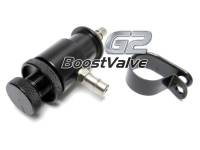
What It Is
A manual boost control valve that acts as a safety device, protecting your turbo in case of a control system failure. The BoostValve is an adjustable pressure relief valve, sometimes called a gated valve, but it is not a bleeder valve.
How It Works
Inside the valve, a precision stainless steel ball is held in place by spring tension. During turbo spool-up, spring tension stays greater than the rising boost pressure, so the ball blocks air from reaching the wastegate actuator, letting the turbo use the maximum available exhaust energy to spin up efficiently. Once boost reaches your preset level, the valve opens quickly, actuating the wastegate and holding boost at that level with accuracy that's hard to match even with more expensive boost control methods.
Why Not Just Use a Bleeder Valve
A bleeder valve stays open all the time, venting off part of the boost pressure so the wastegate only sees a portion of it. That wasted air can act like a leak in your engine's control system, and it also causes the wastegate to open earlier than it should, adding turbo lag. The BoostValve avoids both problems by staying fully closed until your preset boost level is actually reached.
Solving Boost Spike and Surge
Boost spike and surge are common issues on the VW TDI VNT turbo, often caused by back pressure, excess fuel, or soot buildup restricting the catalytic converter or exhaust over time. When the ECU detects a spike or surge, it pulls timing to compensate, which lowers torque output. The BoostValve isn't meant to raise your maximum boost. Instead, it controls spike and surge and gives you better command over the wastegate, eliminating that surging and the resulting power loss.
G2 Series Features
What's in the Kit
Everything needed for installation: injection-grade clamps, high-temperature chemical-resistant hose, and quality American-made nylon fittings and caps.
Installation
Most installs take under 30 minutes with basic hand tools. Easy-to-follow instructions and tuning suggestions are included, along with a two-part installation video. Keep the hoses as short as possible and mount the valve under the hood rather than inside the car, both for the fastest valve response and because adjusting boost while driving isn't something you want to do anyway.
Adjusting Your Boost
Turn the cap to adjust: screwing it in raises boost, unscrewing it lowers boost. With the standard low-pressure spring, one full turn changes boost by roughly 1.5 psi. A good starting point for most cars is to screw the cap all the way in, then back it out 6 turns. Always snug the locknut with a wrench before a test drive so the cap can't vibrate loose.
Boost Range
From your car's stock wastegate setting up to approximately 21 psi. High-boost springs are available separately and are included in kits built for that range.
Fitment
1998-2006 Volkswagen Golf, Jetta, New Beetle, and Passat with a VNT turbo (ALH, BEW, BHW).
Common Questions
Do I need a boost gauge to use this?
Not strictly, but it helps a lot. A gauge lets you see your stock boost level as a reference point and confirm exactly what you're running after installing the valve.
My boost won't go above the stock level no matter how far I turn the cap. What's wrong?
The stainless ball inside may not be sealing properly due to debris or oil contamination. Unscrew the cap and clean the inside of the valve with brake cleaner or isopropyl alcohol. Avoid WD-40 or carb cleaner, since both leave a sticky residue that can cause the same problem again.
Does this valve require regular maintenance?
No. It's built from billet aluminum and stainless steel and should be essentially maintenance-free. If it ever needs attention, it can be disassembled and cleaned easily.
Can I install this inside the car for easier access to adjust boost while driving?
It's not recommended. Longer hose runs from the valve to the turbo slow the valve's response and add to lag, and adjusting boost while driving isn't a safe practice regardless.